
 English
 Türkçe
All-on-4 Implants.
Understand full-arch implant rehabilitation and the questions to ask a qualified dental specialist.
About the service.
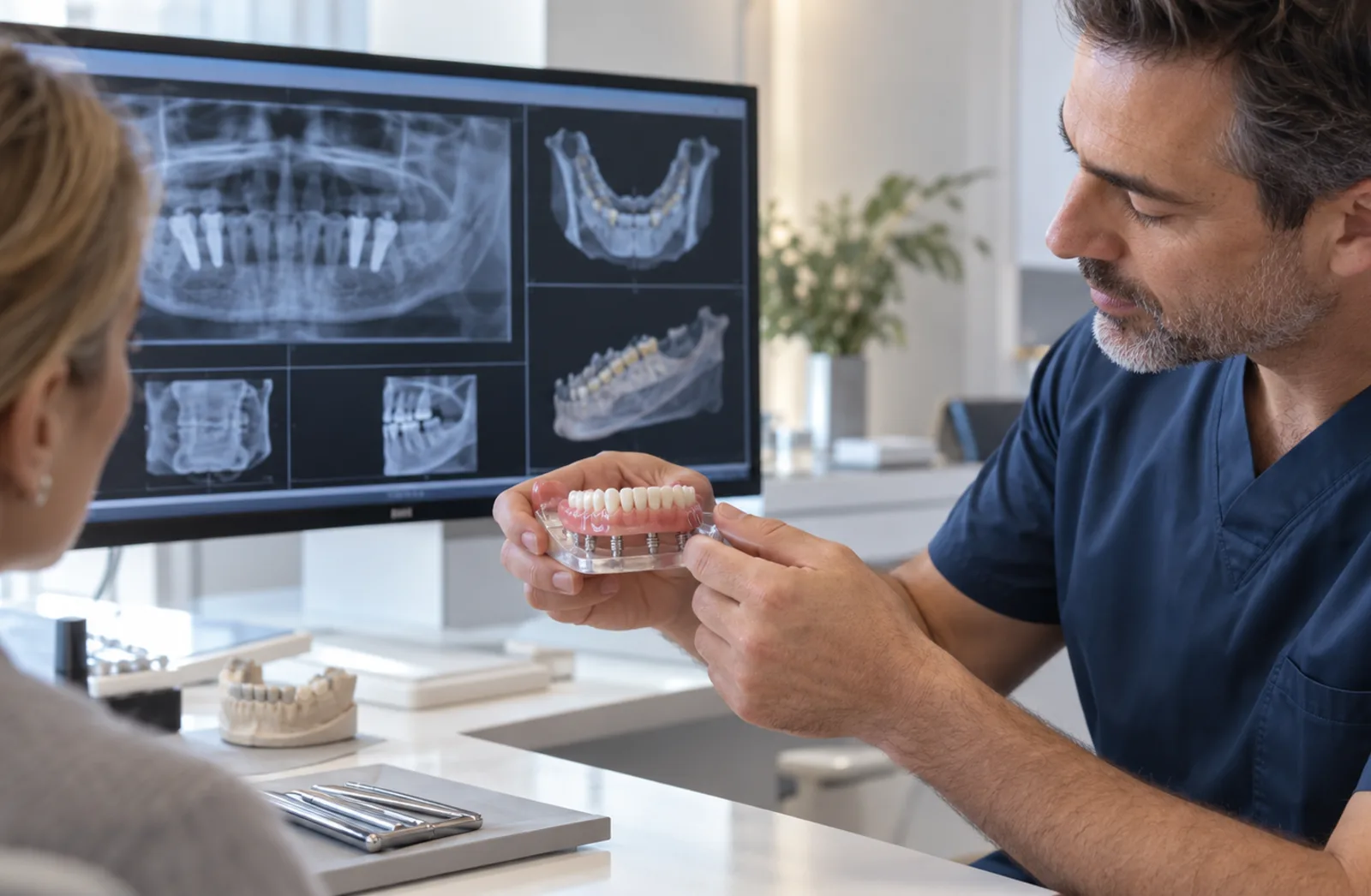
All-on-4 describes a full-arch restoration concept in which a fixed prosthesis may be supported by four implants. The name describes a planning approach, not an automatic promise that four implants are suitable for every jaw.
Dental decisions should connect diagnosis, function, preservation of healthy tissue and long-term maintenance. A remote conversation can clarify questions and records, but it cannot replace examination by the dentist responsible for treatment.
What an individual assessment should cover
The treating team evaluates remaining teeth, infection, bone volume and quality, jaw relationships, bite, hygiene capacity, medical history and expectations. Three-dimensional imaging may be required. Upper and lower jaws can present different constraints.
An appropriate consultation should distinguish general education from a personal recommendation. Relevant medical or dental history, medicines, allergies, previous procedures and current symptoms should be shared securely with the treating provider rather than placed in advertising pixels or public messaging tools.
Approaches and alternatives
Alternatives can include a removable denture, an implant-retained removable overdenture, a fixed restoration supported by a different number or position of implants, staged treatment or preservation of suitable teeth. “Fixed” does not mean maintenance-free.
A useful plan explains why an approach is proposed, what reasonable alternatives exist and what may happen if treatment is postponed or declined. It should also identify which parts of the plan are provisional until direct examination.
Benefits, limits and risks
Full-arch treatment combines surgical and prosthetic risks. Possible issues include healing complications, implant loss, infection, altered speech or chewing during adaptation, prosthetic wear, fracture and hygiene difficulty. Immediate temporary teeth may not be appropriate in every case.
Risk is personal. The treating professional should discuss common and serious complications, factors that may increase risk, warning signs and the provider’s process for managing an unexpected outcome. Marketing language is not informed consent.
Recovery, follow-up and long-term care
The team should explain temporary-restoration precautions, cleaning under the prosthesis, review intervals and who responds to loosening, fracture, pain or swelling. Long-term professional maintenance is part of the treatment, including after the patient returns home.
Recovery dates cannot be promised before an individual plan exists. Travel arrangements should remain flexible enough for required reviews, and a patient should know who to contact locally and internationally if recovery does not follow the expected course.
What affects the total cost?
A complete estimate should clarify extractions, imaging, sedation, grafting, implant components, temporary and definitive prostheses, material, laboratory stages, follow-up and possible repair policies.
Ask for the treating provider’s written plan and a clear breakdown of included and excluded services. Flights, accommodation, transfers and coordination should be distinguished from clinical fees, medicines, tests, maintenance and possible future treatment.
Questions to take to the treating provider
- Why is a four-implant design proposed for this jaw?
- What alternatives were considered and why?
- Is the planned prosthesis temporary or definitive?
- Who provides maintenance and urgent support after travel?
How Estelion coordinates the journey
Estelion Medical acts as a health-tourism intermediary and coordinator. With the visitor’s permission, the coordination team can help organise communication with an authorised healthcare provider, collect non-sensitive planning details, clarify appointment and travel logistics and explain which provider will make clinical decisions. Diagnosis, consent, treatment and clinical follow-up remain the responsibility of the licensed treating professionals and facility.
Before travelling, confirm the provider identity, the named clinician or responsible team, the provisional scope, the records still required, the expected local review period and the contact route for urgent concerns. Do not rely on a social-media promise or an image of another person’s outcome as evidence that the same plan is suitable for you.
Independent background sources
These links provide general patient information. They do not endorse Estelion or replace advice from the treating provider.
The information provided here is of a general nature; it is not a substitute for a personalised assessment by a healthcare professional.
How does the coordination process work?
Tell us what you need
Complete a brief preliminary application without sharing any sensitive health information.
Let’s discuss the options
Our coordinator can explain the process and arrange for an appropriate professional assessment.
Plan your journey
Find out about dates and travel details based on current availability.
Frequently Asked Questions
01Does All-on-4 mean four implants are always enough?+
No. Implant number and position must follow individual examination, imaging and restorative planning.
02Are teeth always fitted on the same day?+
Not always. Immediate loading depends on stability, bone, bite and the treating team’s judgement.
03Is the restoration permanent?+
It is designed as a fixed restoration in many plans, but components can wear and require professional maintenance or replacement.
04How is it different from a removable denture?+
A fixed implant-supported restoration and a removable denture differ in support, cleaning, maintenance, surgery and cost.
Our areas of expertise

ESTELION
Partner healthcare organisations



Let’s start by getting to know each other.
A few quick questions will help us find the best way to get in touch with you.